- Distribution of Hindus in India
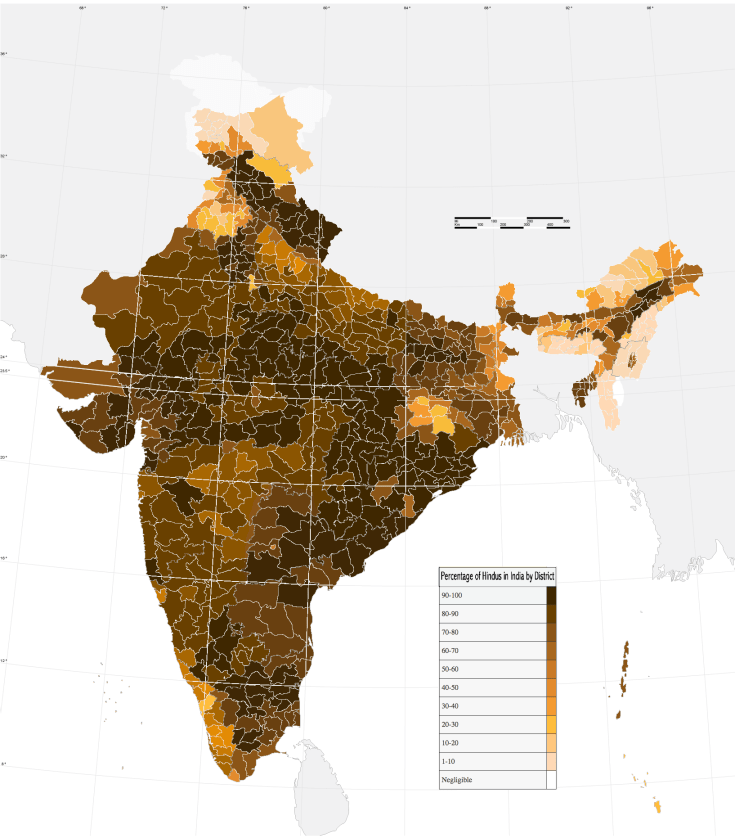
2. Distribution of Muslims in India

There’s a lot you can tell about the subcontinent’s history from this particular map:
- Partition in the West v/s the East: The states of former Greater Punjab in the Northwest have a very low proportion of Muslims as cross-migration along the border of the newly formed West Pakistan and India was very effective(and violent). On the East, around Bangladesh(then East Pakistan), farmers were more reluctant to leave their lands and violence was mostly concentrated in bigger cities.
- The densely forested regions of Orissa and Chhattisgarh(Central-East), and the North-Eastern Himalayas, primarily populated by tribals, were never under direct Islamic influence for long.
- In the South, Kerala was the first place to come in contact with Islam after its advent in the Middle East due to its importance in global trade routes.
3. Distribution of Christians in India
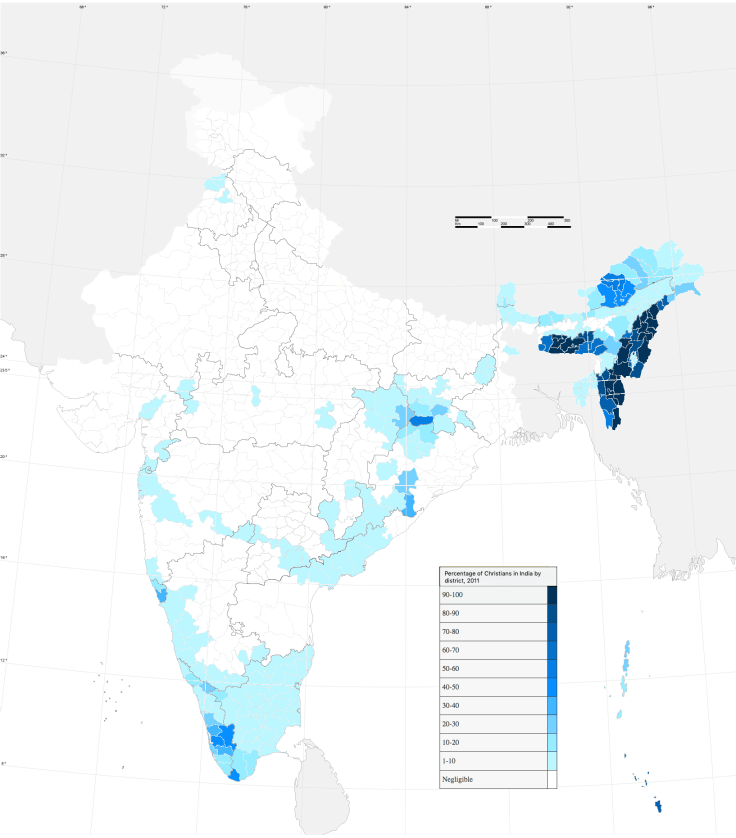
Noteworthy Historical Details:
- Prior to the advent of Christianity in North-Eastern India, each tribe in the forested hills had their own dialect and even faith. Missionaries in the 19th and 20th centuries from Europe and North America were a huge integrating factor for the disjoint clans. For example, Christianity led to the development of nationalist pride among the Naga and Mizo people, who now have their own states within the federation.
- The faith was first introduced in AD 52, by Thomas the Apostle, in what is now Kerala(south-west coast), which still survives today, see Syro-Malabar Church.
4. Distribution of Sikhs in India

- Sikhs are primarily concentrated in Indian Punjab.
- Migrants from West Punjab settled in major cities in India.
- Due to the high proportion of Sikhs in the army, the ethno-religious group is also well-established in border regions.
5. Distribution of Buddhists in India
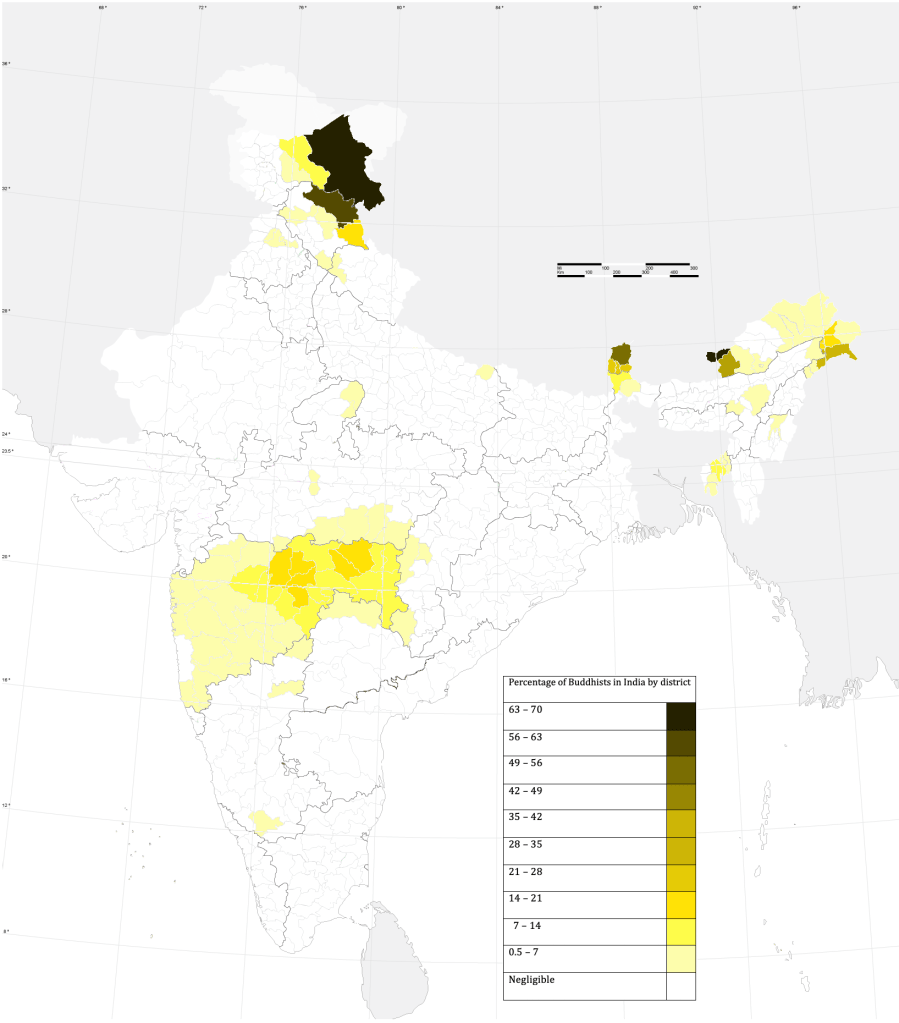
- Despite the fact that Buddhism started off in India, in and around modern-day Bihar, Buddhism is only found in a few pockets along the border with Tibet and in Maharashtra.
- The primary reason for the decline in Buddhism since ancient times is that much of what Buddha advocated for was soon absorbed into the folds of Hinduism, with many adopting the
- Despite the fact that Buddhism started in India( in and around modern-day Bihar), Buddhism is only found in a few pockets along the border with Tibet and in Maharashtra.
- The primary reason for the decline of Buddhism in India is that much of what Buddha advocated for was soon absorbed into the folds of Hinduism, with many adopting the reforms while remaining Hindu.
- In the 20th century, BR Ambedkar, Chairman of India’s Constitution Drafting Committee called out the poor treatment of lower castes in Hindu society and openly converted to Buddhism at Nagpur, Maharashtra. Hundreds of thousands were inspired by him and followed suit, which led to a revival of Indian Buddhism(In the Himalayas it is primarily Tibetan Buddhism).
6. Distribution of Jains in India

- Jainism is a religion which predates Christianity and Islam and was popularised by Mahāvīra, who like Gautam Buddha, left a life of luxury to find a higher purpose(and, like Gautam Buddha was also from what is now Bihar).
- The religion is often termed the world’s most peaceful due to its strictly followed doctrine of ahimsā, or non-violence towards all living beings, which Gandhi adopted as he led India’s independence movement in the early 20th century.
- Unlike Buddhism, Jainism remained confined to the Indian subcontinent and due to its more stringent rules, did not gain as many adherents.
- Nevertheless, Jains today number around 5 million and have the highest literacy rate and per capita income among other religious groups in India.
All data has been taken from India’s 2011 census
 Khaki Jungle